Dr. Mohamemd Reda Chakkor. PhD Naval Architect & Marine Engineer
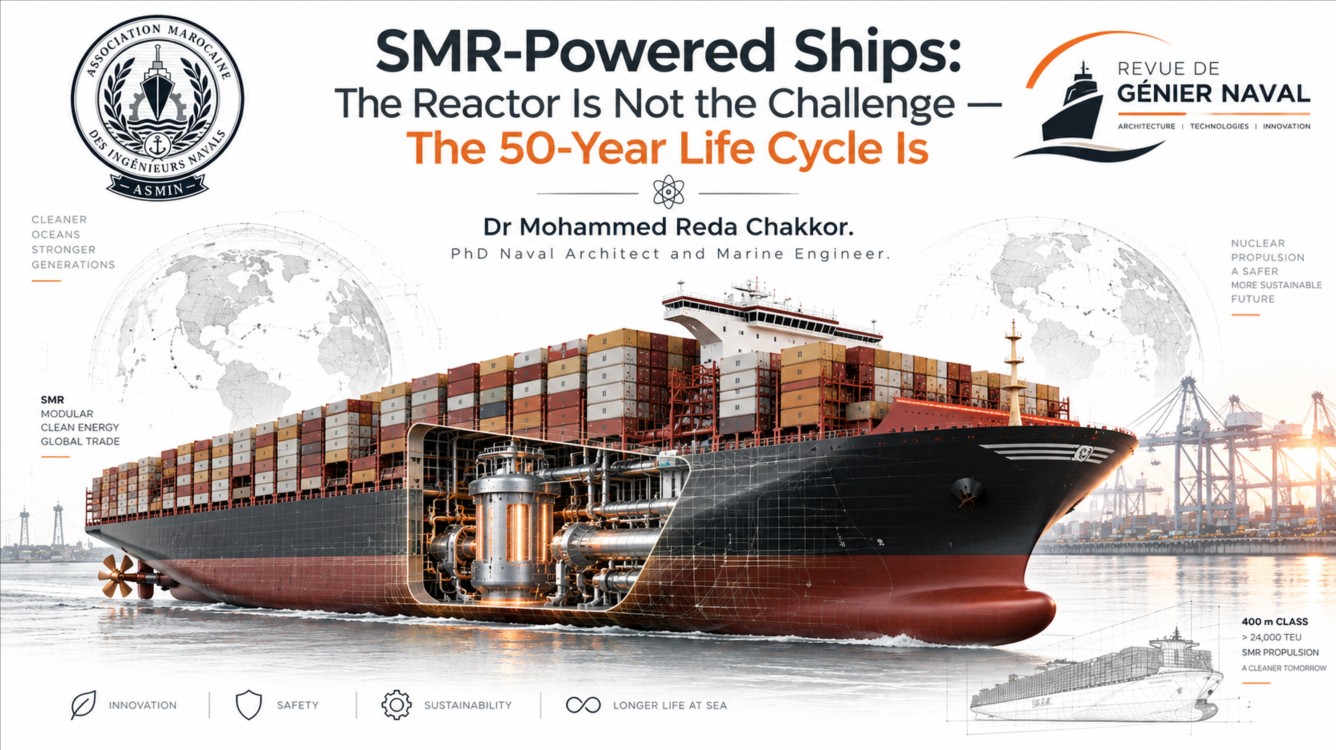
SMR-Powered Ships: The Reactor Is Not the Challenge — The 50-Year Life Cycle Is
Design, maintenance, training and asset management for the next generation of nuclear-powered commercial vessels
Meeting the IMO’s zero-emission ambition for international shipping by 2050 will not simply be a matter of selecting a new fuel.
For the largest ocean-going vessels, the transition requires a system-level approach in which propulsion technology, ship design, capital investment, operating costs, safety, maintenance and asset longevity are considered together.
This is where Small Modular Reactor (SMR) propulsion becomes particularly interesting.
But the most important question may not be whether an SMR can propel a large containership.
It is:
How do we design, operate, maintain and manage that vessel for 50 years or more?
Why 50 years?
The answer begins with economics.
Different vessel segments require fundamentally different propulsion strategies.
For coastal shipping, where propulsion requirements may be around 30 MW or less, electricity and battery-based solutions may become economically attractive.
For medium-sized ocean-going vessels requiring approximately 50 MW, methanol or ammonia could offer viable alternatives depending on the operational profile.
But for large and ultra-large ocean-going vessels, where propulsion requirements may reach 80 MW or more, SMR-based nuclear propulsion could become an increasingly interesting option.
There is, however, a fundamental economic obstacle.
An SMR-powered vessel is expected to cost substantially more to build than a conventional vessel of equivalent type and size — potentially around two times or more.
That changes the economics of the asset.
If the initial capital investment is significantly higher, the owner cannot necessarily evaluate the ship using the same economic assumptions applied to a conventional vessel with an approximately 25-year design life.
The additional CAPEX needs time to generate a return.
This is one of the fundamental reasons why the design life of an SMR-powered commercial vessel may need to move towards 50 years or more.
And if the vessel is expected to remain economically viable for 50+ years, the SMR itself must be designed accordingly — potentially with a design life of at least 50 years and preferably around 60 years, subject of course to the specific reactor technology, regulatory framework and safety case.
The logic is therefore relatively simple:
Higher CAPEX → longer asset life → longer period for capital recovery → greater importance of life-cycle economics.
But this apparently simple equation hides a much more complex engineering problem.
A 50-year design life is not a 50-year guarantee
Designing a ship for a fatigue life of 50 years is technically possible.
But design life and actual service life are not the same thing.
A ship’s real condition will depend on how it is operated and maintained throughout its existence.
Corrosion rates.
Coating condition.
Loading cycles.
Loading patterns.
Wave environment.
Routing.
Operating profile.
Repairs.
Structural modifications.
Thickness diminution.
Maintenance quality.
Inspection quality.
And, ultimately, the quality of operational management.
All of these factors influence the actual life of the asset.
A theoretical 50-year fatigue design does not automatically produce a 50-year ship.
In fact, this becomes even more critical when the vessel contains a high-value nuclear propulsion system.
The last thing we want is a situation where the reactor has decades of remaining technical life while the surrounding ship structure, systems or equipment become the limiting factor.
The SMR must not become the most durable component inside an ageing ship.
More steel is not necessarily the answer
There is an understandable temptation to increase structural margins when designing for a much longer service life.
But engineering always involves trade-offs.
Additional thickness can increase structural robustness and provide greater corrosion allowance.
However, additional steel also means:
more lightweight → more displacement → potentially higher resistance → potentially higher energy requirements.
The solution cannot therefore simply be:
“Add more steel and design for 50 years.”
The objective should be to achieve the optimum balance between structural integrity, weight, energy efficiency, maintainability and life-cycle cost.
This is where advanced structural analysis, fatigue assessment, corrosion management, condition monitoring and inspection planning become fundamental.
The 50-year ship has to be engineered as a system.
The operational reality of ageing ships
There is another important consideration.
Even under current industry practice, many vessels remain in service well beyond their nominal design life.
A ship designed for approximately 25 years may operate for 30 or even 40 years, depending on its condition, maintenance history, market conditions and economic viability.
This operational reality is particularly relevant to marine SMRs.
If the ship itself continues operating beyond its nominal design life, the propulsion system cannot simply be designed around an optimistic theoretical lifetime.
The safety case needs to consider the actual potential operating life of the complete asset.
This suggests that a marine SMR should have sufficient design margin to accommodate a vessel life extending significantly beyond its nominal design life.
The relationship becomes:
SMR Life ≥ Ship Design Life ≥ Expected Operational Life
with appropriate safety and ageing-management margins.
The 50-year challenge is therefore an ageing-management challenge
A 50-year ship will require a fundamentally different maintenance philosophy.
Traditional preventive maintenance will remain essential.
But it will need to be complemented by:
- Condition-Based Maintenance;
- Predictive Maintenance;
- Structural Health Monitoring;
- Non-Destructive Testing;
- corrosion monitoring;
- fatigue-life assessment;
- digital twins;
- remote diagnostics;
- equipment obsolescence management;
- and continuous technical data analysis.
The vessel needs to develop a digital memory throughout its life.
Every inspection.
Every thickness measurement.
Every crack.
Every repair.
Every modification.
Every machinery failure.
Every replacement.
Every operating anomaly.
This information should become part of the asset’s permanent technical history.
The objective is not simply to know whether the ship is safe today.
It is to understand how the ship is ageing.
Maintenance starts at the design office
For conventional ships, maintainability is sometimes treated as an operational consideration.
For a 50-year SMR vessel, it must become a design parameter.
Equipment must be accessible.
Critical components must be replaceable.
Inspection points must be designed into the vessel.
Systems must allow future upgrades.
Interfaces must accommodate technological evolution.
And long-term spare-parts availability must be considered from the beginning.
Because what happens in 2045 if a critical electronic component installed in 2026 is no longer manufactured?
This is not a minor procurement issue.
For a 50-year asset, technological obsolescence can become as important as corrosion or fatigue.
The human factor: a 50-year competence strategy
There is another element that cannot be overlooked:
people.
The crew operating the vessel in 2070 will obviously not be the crew that commissions it.
The same applies to technical superintendents, shore-based engineers, maintenance specialists and surveyors.
An SMR-powered ship will require a combination of:
Marine Engineering + Nuclear Safety + Automation + Electrical Engineering + Risk Management + Emergency Response.
Training therefore cannot be considered a one-time investment.
A 50-year ship requires a:
50-Year Competence Strategy.
This means continuous professional development, simulator training, recurrent certification, emergency exercises, maintenance training and structured knowledge transfer between generations.
The challenge is not simply to train today’s crew.
It is to ensure that the organisation remains competent throughout the entire life of the asset.
The Technical Superintendent becomes a Life-Cycle Asset Manager
This could fundamentally change the role of the technical organisation ashore.
The future superintendent of an SMR vessel may need to manage much more than conventional maintenance.
The responsibility could encompass:
- ageing management;
- structural integrity;
- machinery reliability;
- nuclear-system interfaces;
- regulatory compliance;
- technical modifications;
- obsolescence;
- long-term spare-parts strategy;
- dry-docking;
- inspections;
- life-extension projects;
- and asset-value preservation.
The role evolves from:
“Keep the ship running.”
to:
“Keep the asset safe, compliant, reliable, competitive and valuable.”
That is the essence of Life-Cycle Asset Management.
But there is another 50-year problem: the market
Perhaps the most underestimated risk is not technical.
It is commercial.
Shipping markets do not remain static for 50 years.
Trade routes change.
Cargo volumes change.
Port infrastructure changes.
Ship sizes change.
Charterer requirements change.
Regulations change.
Technology changes.
And the value of a vessel in the second-hand market changes.
This creates a fundamental tension.
A shipowner may want a 50-year asset to recover the additional SMR investment.
But shipping companies have historically generated significant value through sale and purchase transactions, fleet renewal and asset cycles.
A vessel designed to remain in service for 50 years changes that dynamic.
The owner is potentially moving from:
shorter asset cycles and periodic renewal
towards:
long-term capital commitment and life-cycle optimisation.
That is not simply an engineering change.
It is a change in the business model.
The 50-year ship must therefore remain economically adaptable
A technically excellent vessel can still become commercially obsolete.
Therefore, the objective should not be to design a ship that simply survives for 50 years.
It should be to design a ship that can evolve for 50 years.
This means considering:
modularity.
upgradeability.
maintainability.
structural monitoring.
digitalisation.
equipment replacement strategies.
future regulatory requirements.
And potentially even different operational profiles throughout the vessel’s life.
The ship delivered in 2026 should not necessarily be the same technological ship operating in 2050.
It should be a platform capable of becoming something different.
From Shipbuilding to Life-Cycle Engineering
This may ultimately be the biggest conceptual change introduced by SMR propulsion.
The traditional model is:
Design → Build → Operate → Sell
The 50-year SMR model may instead become:
Design → Build → Operate → Maintain → Monitor → Upgrade → Extend → Decommission
This requires the integration of naval architecture, nuclear engineering, ship management, maintenance, classification, regulation, insurance, ship repair and asset finance.
The vessel becomes part of a much larger life-cycle ecosystem.
The real question
The SMR debate is often framed around a technological question:
Can an SMR safely and efficiently propel a large commercial vessel?
That is undoubtedly important.
But I believe the more fundamental question is:
Can we design, finance, operate, maintain, train people for, upgrade and ultimately manage that vessel for 50 years or more while preserving its safety, competitiveness and value?
Because the economic justification for SMR propulsion may depend precisely on this extended life.
The reactor may last.
The steel may last.
The machinery may be replaceable.
The technology may evolve.
But the asset-management strategy has to connect all of these elements together.
The future of SMR-powered shipping will therefore not be determined by the reactor alone.
It will be determined by our ability to manage the entire life cycle of the ship.
The reactor is the technology.
The 50-year life cycle is the challenge.
And perhaps the most important principle for the next generation of nuclear-powered commercial vessels is this:
Do not design the ship only for the day it enters service.
Design the asset for the world it will face 50 years later.